



Frameworks, core principles and top case studies for SaaS pricing, learnt and refined over 28+ years of SaaS-monetization experience.
Thank you! Your submission has been received!
Oops! Something went wrong while submitting the form.
.png)

Before going deep into monetizing Agentic AI, the problem we work on every day at Monetizely, we need to understand the structural benefits of this model.
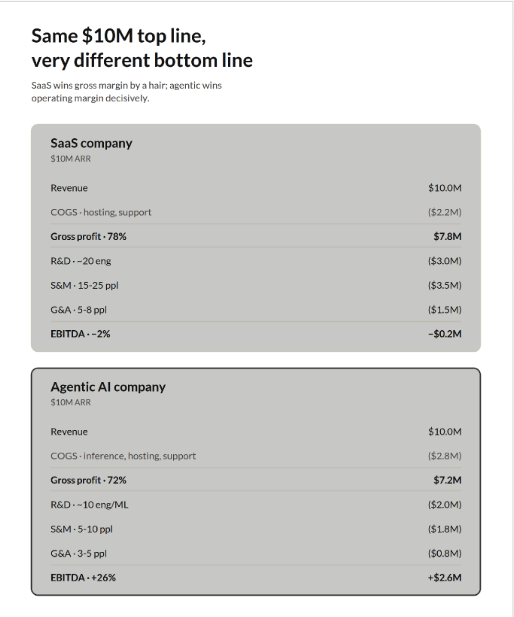
Let’s take two companies, both at $10M in annual recurring revenue. The first is a traditional SaaS company. The second is a well-run agentic AI company. (see Figure 1)
Stare at those two P&Ls side by side. The SaaS company has slightly better gross margins. The agentic company has dramatically better operating margins: 26% EBITDA versus a loss. It needs half the people to deliver the same revenue.
Both companies have the same top line. One is near breakeven while the other throws off $2.6M in operating profit. The agentic company is also selling into a market 10-20x larger than the one the SaaS company addresses. It got to this stage in a quarter of the time.
If the agentic gross margin at 72% surprises you (it looks much closer to SaaS than what you may have read elsewhere), the rest of this chapter explains exactly how each line works and why the agentic P&L is not the margin-compressed catastrophe the conventional narrative suggests. We at Monetizely expect 72% to climb higher as inference costs continue to fall exponentially. Figure 1. Same $10M top line, very different bottom line - identical revenue and near-identical gross margin, but the OpEx structure flips EBITDA from a small loss to +$2.6M.
Join companies like Zoom, DocuSign, and Twilio using our systematic pricing approach to increase revenue by 12-40% year-over-year.