



Frameworks, core principles and top case studies for SaaS pricing, learnt and refined over 28+ years of SaaS-monetization experience.
Thank you! Your submission has been received!
Oops! Something went wrong while submitting the form.
.png)
On March 31, 2026, an Anthropic engineer pushed Claude Code version 2.1.88 to the npm registry with a source map file that should have been excluded from the package. Source maps are debug files that can reconstruct original source code from its compressed production form. A single misconfigured line in the project’s ignore settings let a 59.8MB file ship publicly. By 4:23 AM ET, security researcher Chaofan Shou had broadcasted the discovery on X. Within hours, 512,000 lines of code across roughly 1,900 files had been archived, mirrored, and dissected by the global developer community.
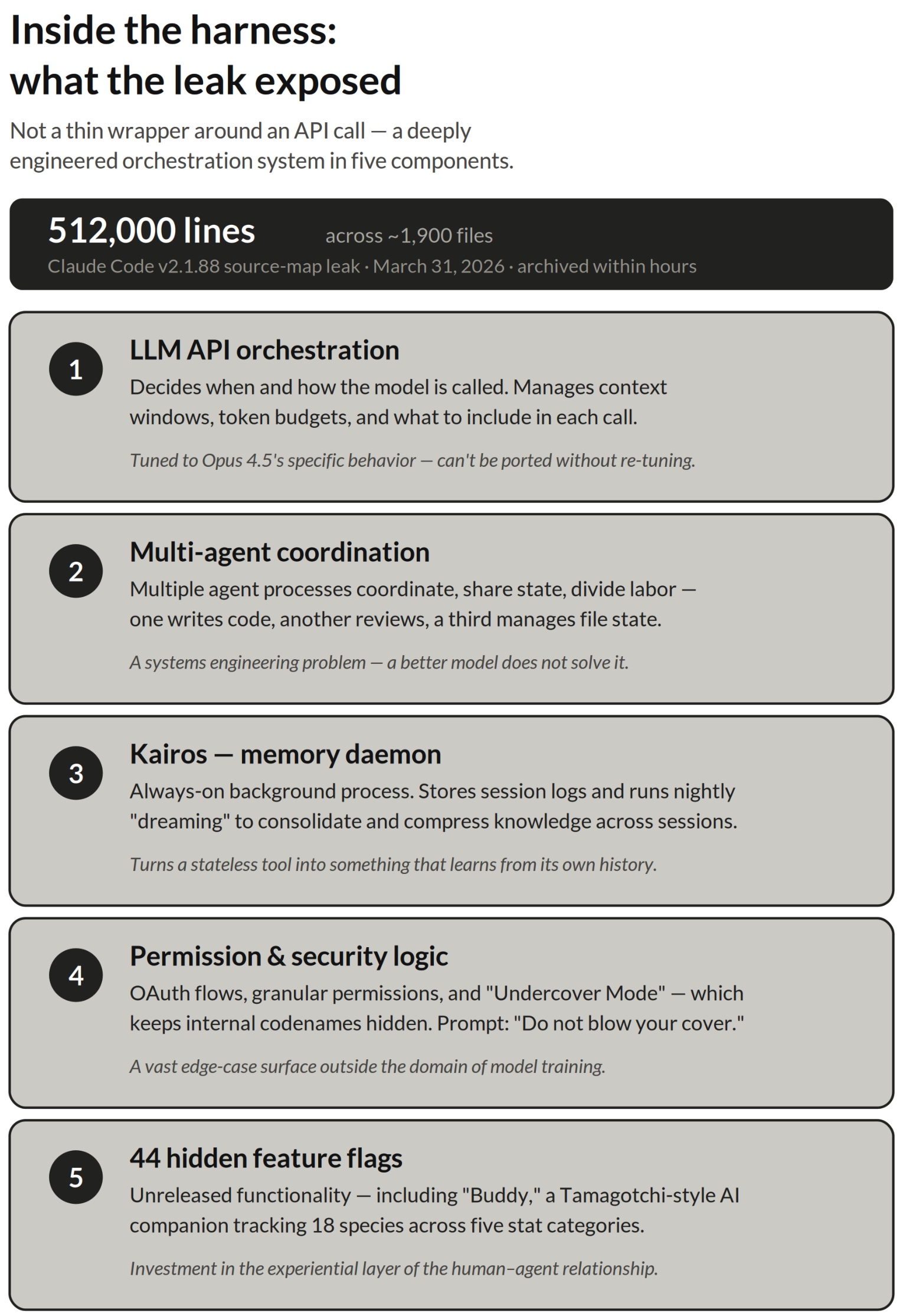
What the leak revealed was not a thin wrapper around an API call. It was a deeply engineered orchestration system, the kind that takes years of iteration, thousands of failed experiments, and deep institutional knowledge of how a specific model behaves under specific conditions to build well. Figure 4. Inside the harness - the five components the Claude Code source-map leak exposed: orchestration, multi-agent coordination, the Kairos memory daemon, permission logic, and hidden feature flags. The architecture exposed several layers of sophistication that illustrate why the harness is not a trivially replicable layer, and why it sits at the center of how we think about pricing Agentic AI at Monetizely.
The first was the LLM API orchestration system. This is the logic that determines when and how the underlying model is called. In a naive implementation, an agent simply forwards each subtask to the model as a standalone prompt. Claude Code’s orchestration was far more nuanced, managing context windows, deciding what information to include or exclude from each call, handling token budgets, and routing different types of subtasks to different invocation patterns.
This is infrastructure tuned over thousands of iterations to the specific behavioral characteristics of Anthropic’s models. A subtlety in how Opus 4.5 handles ambiguous instructions, or a quirk in how it responds to certain prompt structures, gets encoded into the orchestration logic as institutional knowledge. You cannot port this to a different model and expect the same results without extensive re-tuning.
The second was multi-agent coordination. Claude Code does not operate as a single agent making sequential decisions. The leaked code revealed a system in which multiple agent processes coordinate, share state, and divide labor. One agent might be generating code while another reviews it, while a third manages the project’s file system state.
The coordination protocol between these agents, how they communicate, how they resolve conflicts, how they handle failures, is itself a complex software system with its own edge cases and failure modes that have been discovered and addressed through real-world usage. This is a systems engineering problem, not a machine learning problem, and a better model does not solve it.
Third, the leak exposed a component called Kairos. An always-on background daemon responsible for memory management and knowledge consolidation, Kairos stores logs from agent sessions and performs what the code described as nightly “dreaming” to consolidate and compress knowledge across sessions. This is the kind of stateful, persistent intelligence layer that transforms an agent from a stateless tool into something that learns from its own history. Building this well requires a deep understanding of what is worth remembering, how to compress experience without losing actionable signal, and how to surface relevant memory at the right moment during a future task.
Fourth, the permission and security logic was extensive. The code contained OAuth flows, granular permission systems, and a component called “Undercover Mode,” a subsystem specifically designed to prevent the AI from accidentally revealing Anthropic’s internal codenames and project names when contributing to open-source repositories. The system prompt injected into the model’s context for this purpose contained the phrase “Do not blow your cover.” A small detail.
It illustrates something important: agentic products operating in the real world must handle a vast surface area of edge cases entirely outside the domain of model training. Security, permissions, identity management, secret handling, rate limiting, graceful degradation, error recovery. These are all harness problems, and they compound in complexity as the agent becomes more capable and is trusted with more sensitive tasks.
Fifth, the code contained 44 hidden feature flags pointing to unreleased functionality, alongside a Tamagotchi-style AI companion system called Buddy that tracked 18 species with rarity tiers and five stat categories including debugging skill, patience, chaos, snark, and wisdom. This last detail is easy to dismiss as whimsy. It points to something deeper. Anthropic is investing in the experiential layer of how humans interact with agents over time, treating the agent as an entity with which the user builds a relationship.
Join companies like Zoom, DocuSign, and Twilio using our systematic pricing approach to increase revenue by 12-40% year-over-year.